Awards & recognition for S M Hozaifa Hossain.

Honors

CREST 2027 Research Fellow

Siemens EDA HLS: 1st place

IEEE EDS TCAD: winner

Dhaka, Bangladesh

Five recognitions from 2025 to 2026, each with what was built and the numbers behind it.

Awards · 2025 – 2027

Honors & awards

What have
I won?

Selected 30 October 2026 (fellowship January to December 2027)

CREST 2027 Research Fellow

Silicon River Bangladesh (Center for Research Excellence on Semiconductor Technology)

Selected through a competitive national review for the Center for Research Excellence on Semiconductor Technology, supported by Neural Semiconductor Ltd. Project: a TCAD and machine-learning study of how channel curvature limits the number of reliable analog states in GAA FeFET synapses, advised by Dr. Mainul Hossain.

Fellowship: Jan to Dec 2027Advisor: Dr. Mainul Hossain
2026

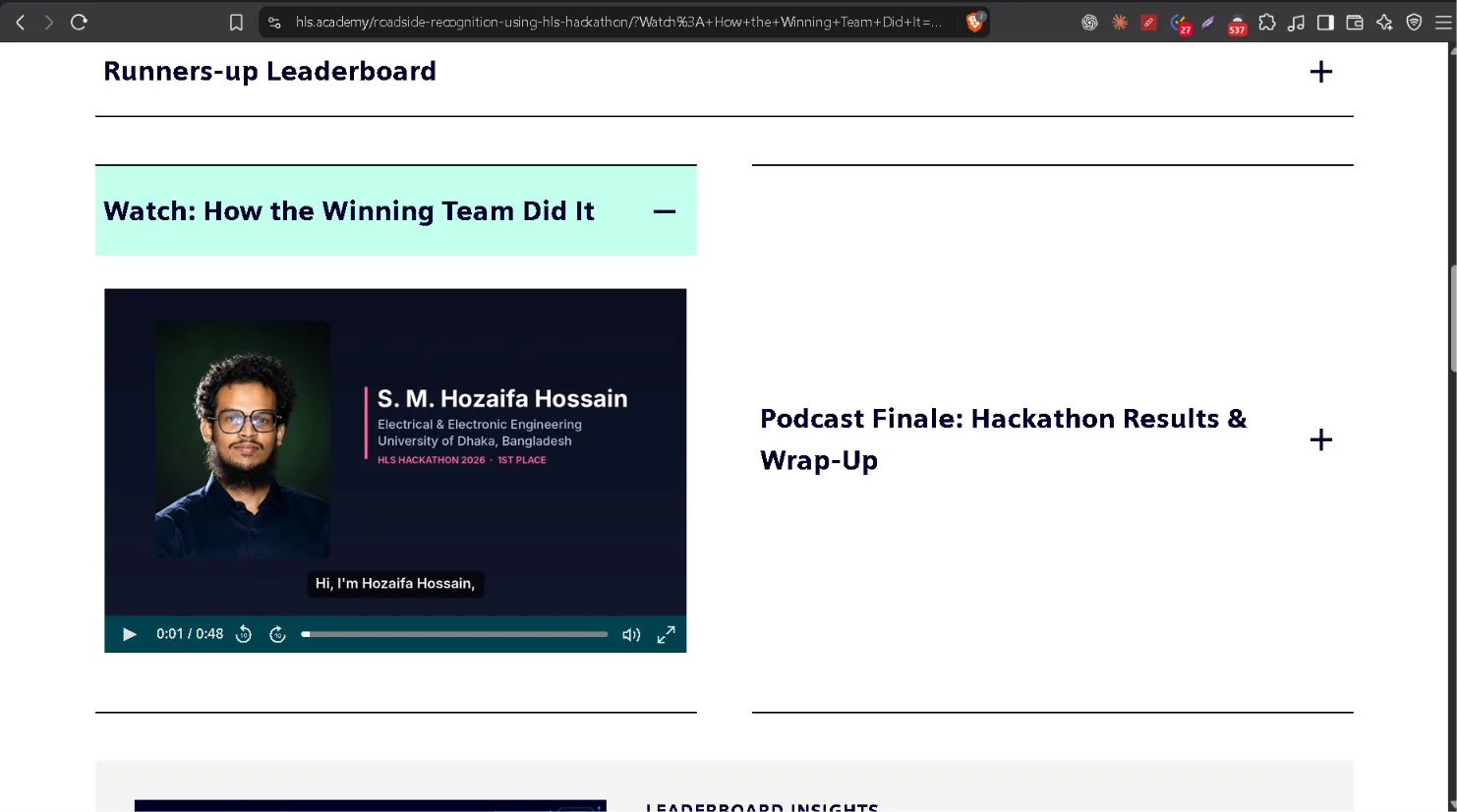
1st Place, Siemens EDA "Accelerating Inferencing Using HLS" Hackathon

Siemens EDA

An ultra-low-power CNN accelerator for edge roadside-object recognition in the Siemens Catapult AI NN high-level synthesis flow: QKeras and hls4ml into Catapult HLS, a 45 nm ASIC library, and PowerPro gate-level power analysis.

Energy per inference 6,877 nJ to 7.51 nJ (915x lower)95.3% accuracy365 synthesis runs

Source: HLS Academy results page ↗

HLS Academy results page for the Roadside Recognition Using HLS hackathon, with the winning-team video
2026

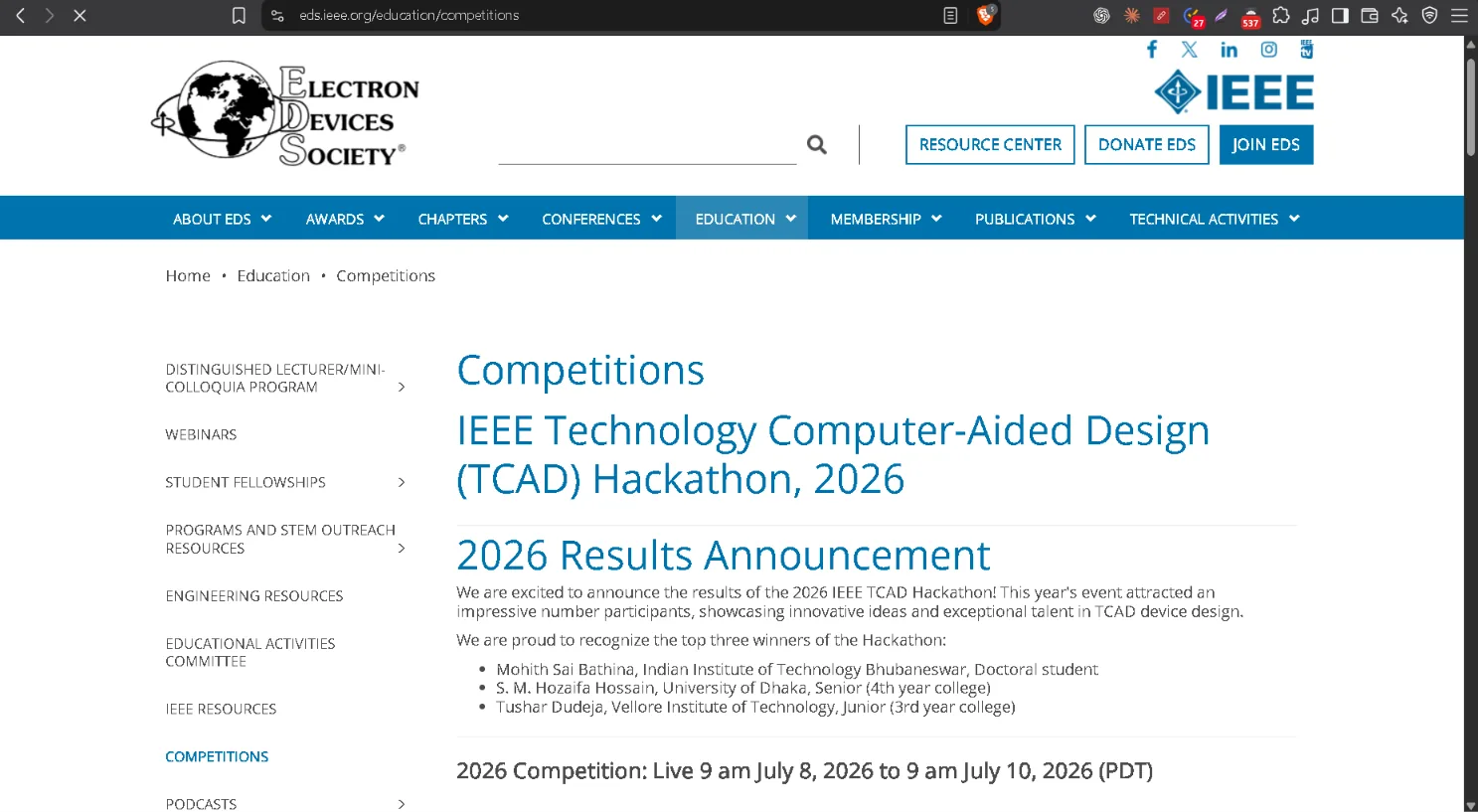
Winner (one of three), IEEE EDS TCAD Hackathon

IEEE Electron Devices Society (EDS) Educational Activities Committee

A sub-10 nm stress-engineered gate-all-around (GAA) silicon nanowire nMOS, designed, simulated and optimized in Synopsys Sentaurus TCAD on consumer hardware, showing quantum transport and subthreshold physics. Geometry: gate length 15 nm, diameter 6 nm, EOT 0.9 nm. I am the first winner from Bangladesh.

+35% ION and +32% gm from 1 GPa uniaxial tensile stressSS 61 mV/dec at VDD 0.7 VION/IOFF 5.5e6, IOFF 0.99 pA

Source: IEEE EDS competitions page ↗

IEEE EDS 2026 TCAD Hackathon results announcement listing the three winners
2026

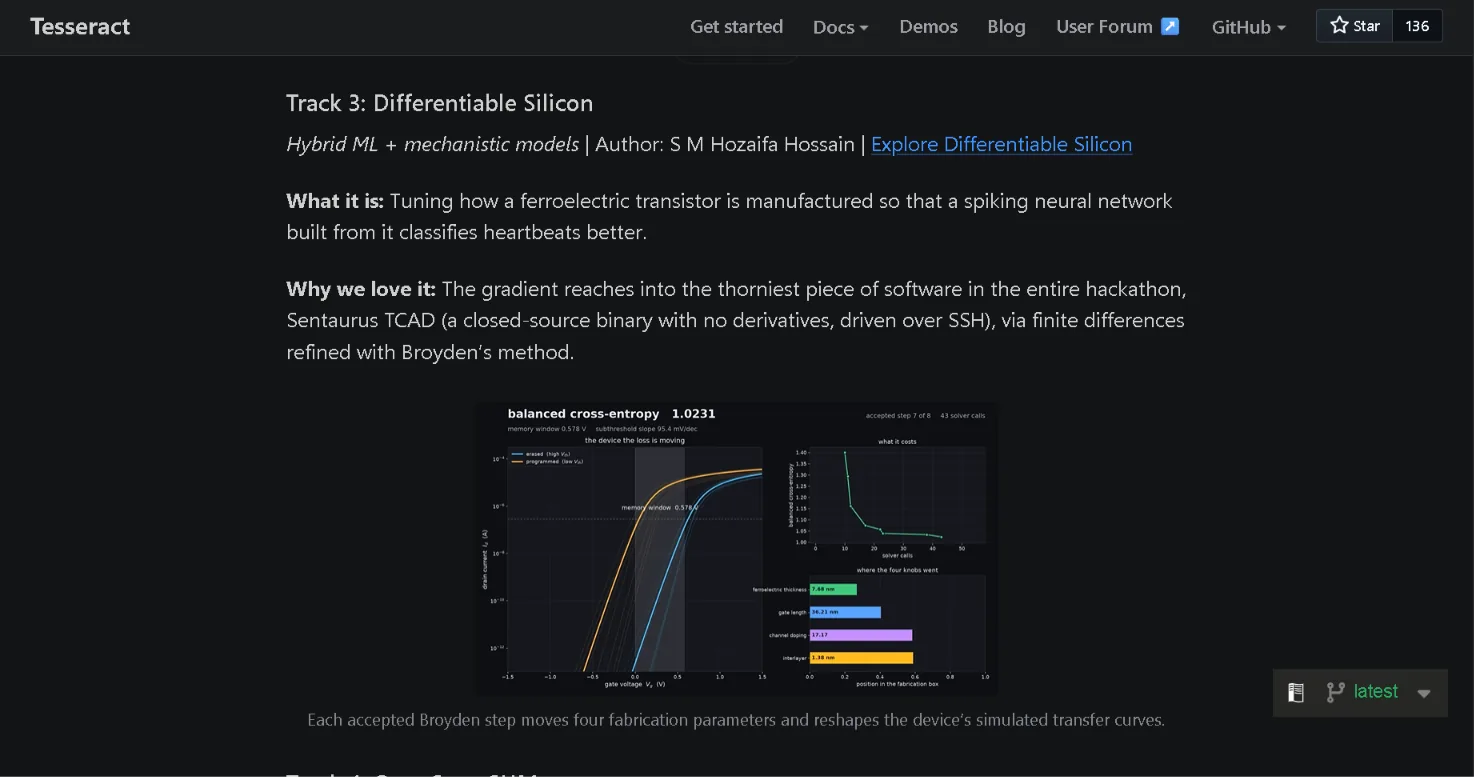
Best-in-Track, Tesseract Hackathon 2026

Pasteur Labs and ISI (Hybrid ML x Mechanistic Models track)

Differentiable Silicon: one gradient carried from ECG classification loss through a PyTorch LSNN and a JAX device-to-neuron transducer into Synopsys Sentaurus TCAD, recovering gradients for four FeFET fabrication parameters. The closed solver binary has no adjoint, so one was built from trust-region finite-difference probes with a Broyden update.

Balanced cross-entropy 1.400 to 1.018Accuracy 0.250 to 0.68864 solver calls

Source: Pasteur Labs winners blog ↗

Pasteur Labs Tesseract Hackathon winners blog, Track 3 Differentiable Silicon

github.com/hozaifa1/differentiable-silicon

2025

IEEE Humanitarian Technologies Board Certificate of Recognition

IEEE HTB Project Monitoring Subcommittee

Awarded for directing and deploying Project 23-HTB-115: energy-efficient Orange Pi computing labs in underserved schools in Netrokona, Bangladesh.

Project 23-HTB-115

Let's build something worth building.